
One Search Brain for Your Storefront and Your AI Assistant: A Retail Leader's Guide to Agentic Commerce

One Search Brain for Your Storefront and Your AI Assistant: A Retail Leader's Guide to Agentic Commerce
One Search Brain for Your Storefront and Your AI Assistant: A Retail Leader's Guide to Agentic Commerce

Most Australian and New Zealand retailers have spent years tuning their storefront search, and many still lose shoppers at the search bar. Research from Algolia suggests 39% of shoppers leave a site after a failed search, and Klarna reports that 77% of Australian shopping journeys begin with search. At the same time, shoppers are getting used to simply asking an AI assistant for what they want. Google's response is Gemini Enterprise for Customer Experience, which brings search, recommendations and shopping agents together on one platform. In this post, we'll explore what an "agentic storefront" means in plain language, how the pieces fit together, and what retail leaders should get right before investing in one.
Why storefront search and support keep letting shoppers down
Two problems sit behind most poor online shopping experiences. They are usually treated as separate projects, which is part of the issue.
Search that breaks on real questions
Traditional search matches keywords. It copes with "blue jacket" but struggles with "waterproof jacket for trail running under $160". The shopper gets a "no results" page or a long list of filters to work through, and many simply leave.
Shopping and support that don't talk to each other
The search bar, the recommendation carousel, the checkout and the support chatbot often run on different systems. When a shopper moves from browsing to buying to asking for help, each system starts from zero. The shopper has to explain themselves again, and the retailer loses the context that would have made the next step easy.
What an agentic storefront looks like
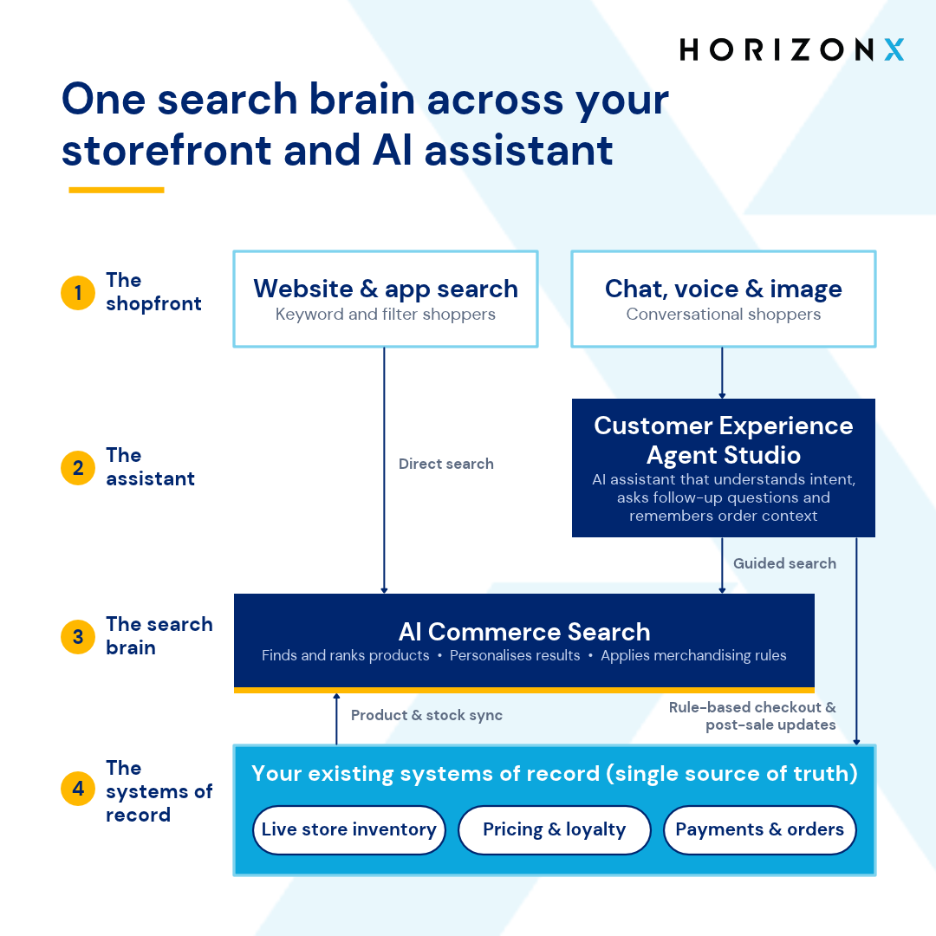
An agentic storefront is one where an AI assistant can search, recommend, build a cart and help after the sale, using the same product data and business rules as your website. Our proposed design has four layers:
- The shopfront: Your website, app, chat and voice channels. This is where shoppers ask for what they want, in whatever way suits them.
- The assistant: The AI agent that understands the request and decides the next step. On Google Cloud, this is built and managed in Customer Experience Agent Studio.
- The search brain: AI Commerce Search (formerly Vertex AI Search for Commerce). It finds and ranks products, personalises results and applies your merchandising rules.
- The systems of record: Your inventory, pricing, loyalty, payment and order systems. These stay the single source of truth.
The most important design choice is that your website and your assistant share one search brain. A shopper should never get one answer from the search bar and a different one from the chatbot. Every click, cart and purchase across both channels trains the same personalisation engine.
One shopper journey, start to finish
Let's follow a single request through those four layers. A shopper says: "I need a waterproof trail jacket under $160 that I can pick up today."
- Discovery: The assistant passes the request to the search brain, along with the shopper's local store. It returns jackets that are in stock nearby for Click & Collect, then asks one useful question: which size and colour?
- Purchase: The shopper chooses, and the assistant hands over to a fixed, rule-based checkout. Prices, loyalty discounts and payment are handled by your existing systems, not by the AI's best guess.
- After the sale: The shopper asks to collect from a different store. The assistant already knows the order, so it makes the change without asking the shopper to start again. If a complex issue ever needs a human team member, the full conversation and order history hand over automatically.
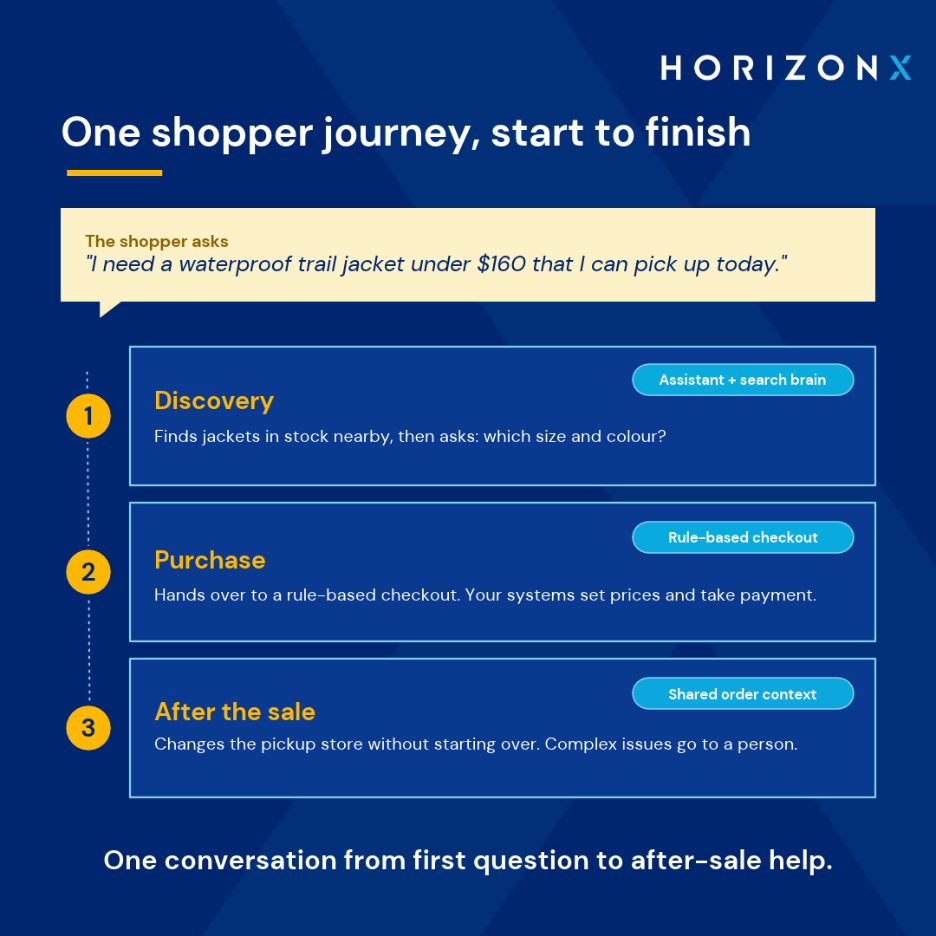
That is one conversation from first question to post-purchase help, with nothing lost along the way.
Three things to get right before you add an agent
An AI assistant is only as good as what sits underneath it. In our view, three foundations matter most:
- Clean product data comes first: If sizes and colours of the same jacket are not grouped properly, results fill up with duplicates. If attributes like material or fit are missing, the assistant cannot filter on them.
- Put merchandisers in control: Your team should be able to promote, demote and hide products through settings, without waiting for a code release.
- Keep money decisions rule-based: Let AI handle language and discovery. Stock, pricing and payments should stay with the systems that already own them.
This is also not the right first step for every retailer. If your search already fails on simple queries, fix that before adding a conversational layer on top.
Where to start
Agentic commerce is less about adding a chatbot and more about giving every channel the same understanding of your products and your shoppers. Retailers who get the foundations right can add an assistant with confidence. Those who skip them tend to automate the problems they already have.
If you're unsure how your storefront search performs today, start with our free AI Search Revenue Leak Checklist or ask us about a complimentary AI Search Diagnostic. Contact us and our team can help you build a clear, scalable path to measurable results.
Subscribe for insights
Most Australian and New Zealand retailers have spent years tuning their storefront search, and many still lose shoppers at the search bar. Research from Algolia suggests 39% of shoppers leave a site after a failed search, and Klarna reports that 77% of Australian shopping journeys begin with search. At the same time, shoppers are getting used to simply asking an AI assistant for what they want. Google's response is Gemini Enterprise for Customer Experience, which brings search, recommendations and shopping agents together on one platform. In this post, we'll explore what an "agentic storefront" means in plain language, how the pieces fit together, and what retail leaders should get right before investing in one.
Why storefront search and support keep letting shoppers down
Two problems sit behind most poor online shopping experiences. They are usually treated as separate projects, which is part of the issue.
Search that breaks on real questions
Traditional search matches keywords. It copes with "blue jacket" but struggles with "waterproof jacket for trail running under $160". The shopper gets a "no results" page or a long list of filters to work through, and many simply leave.
Shopping and support that don't talk to each other
The search bar, the recommendation carousel, the checkout and the support chatbot often run on different systems. When a shopper moves from browsing to buying to asking for help, each system starts from zero. The shopper has to explain themselves again, and the retailer loses the context that would have made the next step easy.
What an agentic storefront looks like
An agentic storefront is one where an AI assistant can search, recommend, build a cart and help after the sale, using the same product data and business rules as your website. Our proposed design has four layers:
- The shopfront: Your website, app, chat and voice channels. This is where shoppers ask for what they want, in whatever way suits them.
- The assistant: The AI agent that understands the request and decides the next step. On Google Cloud, this is built and managed in Customer Experience Agent Studio.
- The search brain: AI Commerce Search (formerly Vertex AI Search for Commerce). It finds and ranks products, personalises results and applies your merchandising rules.
- The systems of record: Your inventory, pricing, loyalty, payment and order systems. These stay the single source of truth.
The most important design choice is that your website and your assistant share one search brain. A shopper should never get one answer from the search bar and a different one from the chatbot. Every click, cart and purchase across both channels trains the same personalisation engine.
One shopper journey, start to finish
Let's follow a single request through those four layers. A shopper says: "I need a waterproof trail jacket under $160 that I can pick up today."
- Discovery: The assistant passes the request to the search brain, along with the shopper's local store. It returns jackets that are in stock nearby for Click & Collect, then asks one useful question: which size and colour?
- Purchase: The shopper chooses, and the assistant hands over to a fixed, rule-based checkout. Prices, loyalty discounts and payment are handled by your existing systems, not by the AI's best guess.
- After the sale: The shopper asks to collect from a different store. The assistant already knows the order, so it makes the change without asking the shopper to start again. If a complex issue ever needs a human team member, the full conversation and order history hand over automatically.
That is one conversation from first question to post-purchase help, with nothing lost along the way.
Three things to get right before you add an agent
An AI assistant is only as good as what sits underneath it. In our view, three foundations matter most:
- Clean product data comes first: If sizes and colours of the same jacket are not grouped properly, results fill up with duplicates. If attributes like material or fit are missing, the assistant cannot filter on them.
- Put merchandisers in control: Your team should be able to promote, demote and hide products through settings, without waiting for a code release.
- Keep money decisions rule-based: Let AI handle language and discovery. Stock, pricing and payments should stay with the systems that already own them.
This is also not the right first step for every retailer. If your search already fails on simple queries, fix that before adding a conversational layer on top.
Where to start
Agentic commerce is less about adding a chatbot and more about giving every channel the same understanding of your products and your shoppers. Retailers who get the foundations right can add an assistant with confidence. Those who skip them tend to automate the problems they already have.
If you're unsure how your storefront search performs today, start with our free AI Search Revenue Leak Checklist or ask us about a complimentary AI Search Diagnostic. Contact us and our team can help you build a clear, scalable path to measurable results.
One Search Brain for Your Storefront and Your AI Assistant: A Retail Leader's Guide to Agentic Commerce
Most Australian and New Zealand retailers have spent years tuning their storefront search, and many still lose shoppers at the search bar. Research from Algolia suggests 39% of shoppers leave a site after a failed search, and Klarna reports that 77% of Australian shopping journeys begin with search. At the same time, shoppers are getting used to simply asking an AI assistant for what they want. Google's response is Gemini Enterprise for Customer Experience, which brings search, recommendations and shopping agents together on one platform. In this post, we'll explore what an "agentic storefront" means in plain language, how the pieces fit together, and what retail leaders should get right before investing in one.
Why storefront search and support keep letting shoppers down
Two problems sit behind most poor online shopping experiences. They are usually treated as separate projects, which is part of the issue.
Search that breaks on real questions
Traditional search matches keywords. It copes with "blue jacket" but struggles with "waterproof jacket for trail running under $160". The shopper gets a "no results" page or a long list of filters to work through, and many simply leave.
Shopping and support that don't talk to each other
The search bar, the recommendation carousel, the checkout and the support chatbot often run on different systems. When a shopper moves from browsing to buying to asking for help, each system starts from zero. The shopper has to explain themselves again, and the retailer loses the context that would have made the next step easy.
What an agentic storefront looks like
An agentic storefront is one where an AI assistant can search, recommend, build a cart and help after the sale, using the same product data and business rules as your website. Our proposed design has four layers:
- The shopfront: Your website, app, chat and voice channels. This is where shoppers ask for what they want, in whatever way suits them.
- The assistant: The AI agent that understands the request and decides the next step. On Google Cloud, this is built and managed in Customer Experience Agent Studio.
- The search brain: AI Commerce Search (formerly Vertex AI Search for Commerce). It finds and ranks products, personalises results and applies your merchandising rules.
- The systems of record: Your inventory, pricing, loyalty, payment and order systems. These stay the single source of truth.
The most important design choice is that your website and your assistant share one search brain. A shopper should never get one answer from the search bar and a different one from the chatbot. Every click, cart and purchase across both channels trains the same personalisation engine.
One shopper journey, start to finish
Let's follow a single request through those four layers. A shopper says: "I need a waterproof trail jacket under $160 that I can pick up today."
- Discovery: The assistant passes the request to the search brain, along with the shopper's local store. It returns jackets that are in stock nearby for Click & Collect, then asks one useful question: which size and colour?
- Purchase: The shopper chooses, and the assistant hands over to a fixed, rule-based checkout. Prices, loyalty discounts and payment are handled by your existing systems, not by the AI's best guess.
- After the sale: The shopper asks to collect from a different store. The assistant already knows the order, so it makes the change without asking the shopper to start again. If a complex issue ever needs a human team member, the full conversation and order history hand over automatically.
That is one conversation from first question to post-purchase help, with nothing lost along the way.
Three things to get right before you add an agent
An AI assistant is only as good as what sits underneath it. In our view, three foundations matter most:
- Clean product data comes first: If sizes and colours of the same jacket are not grouped properly, results fill up with duplicates. If attributes like material or fit are missing, the assistant cannot filter on them.
- Put merchandisers in control: Your team should be able to promote, demote and hide products through settings, without waiting for a code release.
- Keep money decisions rule-based: Let AI handle language and discovery. Stock, pricing and payments should stay with the systems that already own them.
This is also not the right first step for every retailer. If your search already fails on simple queries, fix that before adding a conversational layer on top.
Where to start
Agentic commerce is less about adding a chatbot and more about giving every channel the same understanding of your products and your shoppers. Retailers who get the foundations right can add an assistant with confidence. Those who skip them tend to automate the problems they already have.
If you're unsure how your storefront search performs today, start with our free AI Search Revenue Leak Checklist or ask us about a complimentary AI Search Diagnostic. Contact us and our team can help you build a clear, scalable path to measurable results.
Thank you for submitting the form. The resource has been sent to your email.
One Search Brain for Your Storefront and Your AI Assistant: A Retail Leader's Guide to Agentic Commerce
Most Australian and New Zealand retailers have spent years tuning their storefront search, and many still lose shoppers at the search bar. Research from Algolia suggests 39% of shoppers leave a site after a failed search, and Klarna reports that 77% of Australian shopping journeys begin with search. At the same time, shoppers are getting used to simply asking an AI assistant for what they want. Google's response is Gemini Enterprise for Customer Experience, which brings search, recommendations and shopping agents together on one platform. In this post, we'll explore what an "agentic storefront" means in plain language, how the pieces fit together, and what retail leaders should get right before investing in one.
Why storefront search and support keep letting shoppers down
Two problems sit behind most poor online shopping experiences. They are usually treated as separate projects, which is part of the issue.
Search that breaks on real questions
Traditional search matches keywords. It copes with "blue jacket" but struggles with "waterproof jacket for trail running under $160". The shopper gets a "no results" page or a long list of filters to work through, and many simply leave.
Shopping and support that don't talk to each other
The search bar, the recommendation carousel, the checkout and the support chatbot often run on different systems. When a shopper moves from browsing to buying to asking for help, each system starts from zero. The shopper has to explain themselves again, and the retailer loses the context that would have made the next step easy.
What an agentic storefront looks like
An agentic storefront is one where an AI assistant can search, recommend, build a cart and help after the sale, using the same product data and business rules as your website. Our proposed design has four layers:
- The shopfront: Your website, app, chat and voice channels. This is where shoppers ask for what they want, in whatever way suits them.
- The assistant: The AI agent that understands the request and decides the next step. On Google Cloud, this is built and managed in Customer Experience Agent Studio.
- The search brain: AI Commerce Search (formerly Vertex AI Search for Commerce). It finds and ranks products, personalises results and applies your merchandising rules.
- The systems of record: Your inventory, pricing, loyalty, payment and order systems. These stay the single source of truth.
The most important design choice is that your website and your assistant share one search brain. A shopper should never get one answer from the search bar and a different one from the chatbot. Every click, cart and purchase across both channels trains the same personalisation engine.
One shopper journey, start to finish
Let's follow a single request through those four layers. A shopper says: "I need a waterproof trail jacket under $160 that I can pick up today."
- Discovery: The assistant passes the request to the search brain, along with the shopper's local store. It returns jackets that are in stock nearby for Click & Collect, then asks one useful question: which size and colour?
- Purchase: The shopper chooses, and the assistant hands over to a fixed, rule-based checkout. Prices, loyalty discounts and payment are handled by your existing systems, not by the AI's best guess.
- After the sale: The shopper asks to collect from a different store. The assistant already knows the order, so it makes the change without asking the shopper to start again. If a complex issue ever needs a human team member, the full conversation and order history hand over automatically.
That is one conversation from first question to post-purchase help, with nothing lost along the way.
Three things to get right before you add an agent
An AI assistant is only as good as what sits underneath it. In our view, three foundations matter most:
- Clean product data comes first: If sizes and colours of the same jacket are not grouped properly, results fill up with duplicates. If attributes like material or fit are missing, the assistant cannot filter on them.
- Put merchandisers in control: Your team should be able to promote, demote and hide products through settings, without waiting for a code release.
- Keep money decisions rule-based: Let AI handle language and discovery. Stock, pricing and payments should stay with the systems that already own them.
This is also not the right first step for every retailer. If your search already fails on simple queries, fix that before adding a conversational layer on top.
Where to start
Agentic commerce is less about adding a chatbot and more about giving every channel the same understanding of your products and your shoppers. Retailers who get the foundations right can add an assistant with confidence. Those who skip them tend to automate the problems they already have.
If you're unsure how your storefront search performs today, start with our free AI Search Revenue Leak Checklist or ask us about a complimentary AI Search Diagnostic. Contact us and our team can help you build a clear, scalable path to measurable results.
Download eBook
One Search Brain for Your Storefront and Your AI Assistant: A Retail Leader's Guide to Agentic Commerce
Shoppers now ask an AI assistant for what they want, but most retailers still run search, recommendations, checkout and support on separate systems. This guide explains what an agentic storefront is in plain language. It covers the four layers behind it (shopfront, assistant, search brain and systems of record), follows one shopper from first question to after-sale help, and sets out the three foundations to get right before adding an AI agent: clean product data, merchandiser control and rule-based pricing and payments.
Related Insights


Unlock new opportunities today.
Whether you have a question, a project in mind, or just want to discuss possibilities, we're here to help. Contact us today, and let’s turn your ideas into impactful solutions.